

If SEO were a dinner party, Core Web Vitals in SEO would be that brutally honest friend who doesn’t care how pretty your table setting is—if the food arrives late, spills everywhere, or makes guests wait awkwardly, they’re calling it out. Loudly.
Google introduced Core Web Vitals to answer one simple (but savage) question: Does your website actually feel good to use? Not “does it rank well because you sprinkled keywords like oregano,” but “does it load fast, behave predictably, and respond when humans click things?”
In today’s SERP reality, rankings aren’t just about backlinks and blog length. They’re about experience. And experience is measurable. That’s where Core Web Vitals metrics step in—three performance signals that Google uses to judge whether your website deserves applause… or a quiet demotion.
At Thinkster, we like to call Core Web Vitals the vibe check of your website. You might look great. You might sound smart. But if your site jumps around like a hyper toddler and loads slower than a 2G network in a lift—Google is unimpressed.Let’s break it all down: LCP, CLS, INP (and yes, the now-retired FID), how they impact rankings, and how to improve Core Web Vitals without losing your sanity—or your traffic.
What are the Core Web Vitals (CWV)?
Core Web Vitals (CWV) are a set of performance-focused metrics introduced by Google to quantify real-world user experience. Unlike traditional SEO signals that mostly live in theory, CWV is based on actual user data. That’s right—real humans, real devices, real frustration.
Currently, Core Web Vitals metrics focus on three things:
- Loading performance
- Visual stability
- Interactivity
Google tracks these signals using Chrome user data and evaluates whether your site is good, needs improvement, or please fix this immediately.
Let’s decode each metric—Thinkster style.
What is Largest Contentful Paint (LCP)?
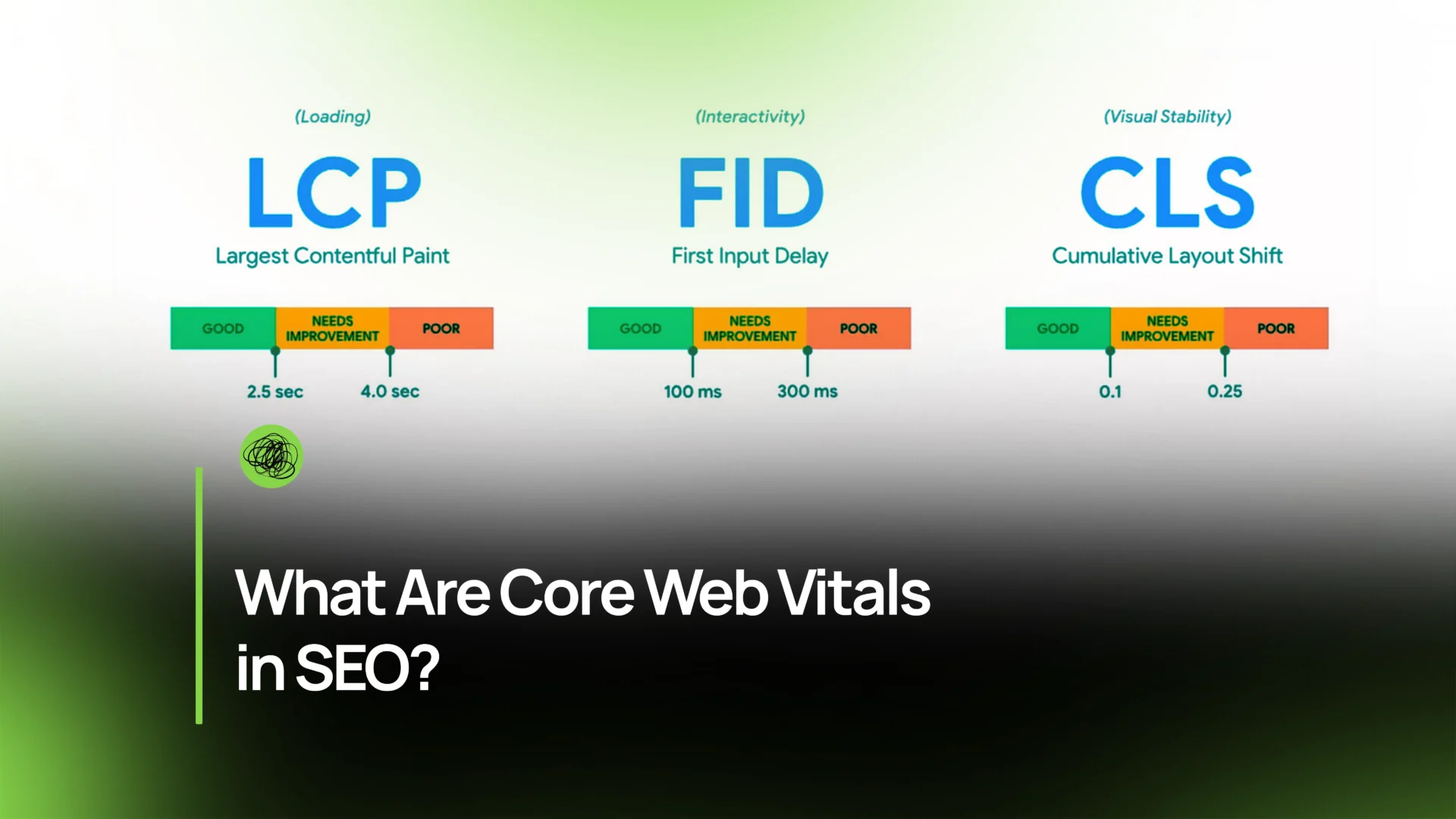
Largest Contentful Paint (LCP) measures how long it takes for the largest visible element on your page to load. Usually, this is a hero image, banner, or large block of text—the thing users actually came to see.
In human terms: When does the page feel loaded?
Google’s benchmarks for LCP:
- Good: Under 2.5 seconds
- Needs improvement: 2.5–4 seconds
- Poor: Over 4 seconds
If your LCP is slow, users assume your site is slow—even if the rest loads fine. And assumptions kill conversions.
Common LCP villains include:
- Heavy images with zero optimization
- Bloated CSS and JavaScript
- Poor server response times
- Chaotic website architecture
At Thinkster, optimizing LCP is usually step one in any serious SEO Services engagement—because if your site doesn’t load fast, nothing else matters.
What is First Input Delay (FID)?
Ah, First Input Delay (FID)—the metric that walked so Interaction to Next Paint (INP) could run.
FID measured the delay between a user’s first interaction (like clicking a button) and the browser’s ability to respond. Essentially, it checked whether your site froze the moment someone tried to do something.
Good FID score:
- Under 100 milliseconds
While FID was useful, it only measured the first interaction. Which is like judging a restaurant solely on how fast the waiter brings water.
Google has now officially replaced FID with INP—but understanding FID still helps explain why INP exists.
What is Cumulative Layout Shift (CLS)?
Cumulative Layout Shift (CLS) measures how much your page layout jumps around while loading. You know that moment when you’re about to click something and—bam—the page shifts and you accidentally tap an ad? That’s CLS ruining lives.
Google’s CLS thresholds:
- Good: Below 0.1
- Needs improvement: 0.1–0.25
- Poor: Above 0.25
CLS issues usually come from:
- Images without defined dimensions
- Ads loading late
- Fonts swapping mid-load
- Poor structural planning in website architecture
CLS doesn’t just hurt rankings—it murders trust. At Thinkster, we treat layout stability like a UX non-negotiable. Because chaos is for reality TV, not websites.
What is Interaction to Next Paint (INP)?
Interaction to Next Paint (INP) is the new kid on the Core Web Vitals block—and it’s far more demanding.
INP measures all interactions on a page, not just the first one. It tracks how quickly your site responds throughout the entire session.
Good INP score:
- Under 200 milliseconds
INP looks at:
- Event handling delays
- JavaScript execution
- Rendering performance
In short, INP answers: Is your site responsive consistently—or only on its best behavior?
This makes INP a more accurate reflection of real-world UX—and a much bigger deal for Core Web Vitals in SEO going forward.
How do the Core Web Vitals Impact SEO?
Let’s settle the debate: Core Web Vitals won’t magically rank terrible content at #1. But if two pages are equally relevant, CWV can absolutely be the tie-breaker.
And in competitive niches, everything is a tie-breaker.
Ranking Impact
Google has confirmed that Core Web Vitals metrics are ranking signals. They fall under the broader “Page Experience” umbrella.
Think of CWV as:
- Not a rocket booster
- But definitely not optional
If your competitors have similar backlinks, content depth, and keyword targeting—and your site loads slower or behaves worse—you lose.
At Thinkster, we’ve seen ranking lifts after CWV fixes without adding new content. That’s the power of experience-driven SEO.
User Experience (UX) and Revenue
Here’s where things get spicy.
Improving Largest Contentful Paint (LCP), Cumulative Layout Shift (CLS), and Interaction to Next Paint (INP) doesn’t just help SEO—it directly impacts money.
Better CWV means:
- Lower bounce rates
- Higher session duration
- Better conversion rates
- More trust
Amazon famously calculated that even a 100ms delay could cost millions. Your business might not be Amazon—but your users are just as impatient.
This is why Thinkster integrates Core Web Vitals optimization into broader SEO Services, UX strategy, and performance design—not as an afterthought, but as a foundation.
Assessment Timeframe
Here’s the tricky part: CWV is based on field data, not just lab tests.
That means:
- Improvements don’t reflect instantly
- Google evaluates performance over ~28 days
- Patience is required (we know, gross)
However, once your metrics stabilize, the gains tend to stick—especially if your website architecture is clean and scalable.
Tooling
To measure and improve Core Web Vitals, you’ll need the right tools. Google-approved ones include:
- PageSpeed Insights
- Google Search Console (CWV report)
- Lighthouse
- Chrome DevTools
At Thinkster, we go beyond surface-level scores. We diagnose why metrics fail and align fixes with SEO strategy—not just developer convenience.
Conclusion
Core Web Vitals in SEO aren’t a trend. They’re Google’s way of forcing the internet to grow up.
LCP ensures your site loads fast.
CLS ensures it behaves itself.
INP ensures it listens when users interact.
Together, they define whether your website is a joy—or a chore.
If your SEO strategy ignores Core Web Vitals, you’re optimizing for yesterday’s Google. And Google hates nostalgia.
At Thinkster, we don’t just chase rankings—we engineer experiences that rank and convert. Because performance, UX, and SEO aren’t separate disciplines anymore. They’re the same game.
And we play to win.
FAQs
1. How to solve Core Web Vitals?</H3>
Start by identifying weak metrics in Google Search Console, then optimize images, reduce JavaScript bloat, improve server performance, and clean up layout shifts. A strategic approach—not random fixes—works best.
2. What are the two types of optimization for SEO?</H3>
On-page optimization (content, structure, CWV, website architecture) and off-page optimization (backlinks, authority, mentions). Modern SEO demands both.
3. What is the meaning of CWV?</H3>
CWV stands for Core Web Vitals—Google’s key performance metrics that measure real-world user experience.
4. What is a good FID score?</H3>
A good First Input Delay score is under 100 milliseconds. However, FID has now been replaced by INP for a more holistic interaction measurement.
5. What is the 80/20 rule in SEO?
Roughly 20% of optimizations (like fixing Core Web Vitals, technical issues, and top pages) often deliver 80% of SEO results. Smart SEO focuses on leverage—not busywork.
If your site’s performance scores are making you nervous—good. That means you’re paying attention. And if you want Core Web Vitals handled without the headache, Thinkster’s SEO Services are built exactly for that.Fast sites win. Stable sites convert. Responsive sites rank.
And Thinkster builds all three.